
Cambodia visas explained
វីសាកម្ពុជា
Almost every visitor needs a visa for Cambodia, and there are three practical routes: apply online for an e-Visa, buy a visa on arrival at the airport or land border, or get one in advance at an embassy. This guide covers cost, validity, extensions and the paperwork that trips people up.
Tourist visa (T)
US$30
30 days, single entry
Business visa (E)
US$35
30 days, extendable in-country
e-Visa processing
About 3 days
Apply at least a week ahead
Who needs a visa, and who does not
Citizens of most countries need a visa to enter Cambodia, including travellers from the United States, the United Kingdom, the European Union, Australia, Canada, Japan and Korea. ASEAN nationals — Thailand, Vietnam, Laos, Malaysia, Singapore, Indonesia, the Philippines, Brunei and Myanmar — can generally enter visa-free for 14 to 30 days depending on nationality.
Your passport must be valid for at least six months from the date of entry and have a blank page for the visa sticker. Immigration officers can refuse entry on a damaged or heavily worn passport, so replace one that is coming apart before you travel.
A small number of nationalities cannot use the e-Visa or visa-on-arrival routes and must apply through a Cambodian embassy with supporting documents. If your passport is from Afghanistan, Algeria, Bangladesh, Iran, Iraq, Nigeria, Pakistan, Saudi Arabia, Sri Lanka, Sudan or Syria, check with the embassy before booking flights.
e-Visa versus visa on arrival
The e-Visa is applied for online through the official government portal, costs US$36 including the processing fee, and is usually issued within three working days. You print the approval letter and hand it over at the border. It is valid for a single entry of 30 days and must be used within three months of issue.
Visa on arrival costs US$30 for tourism or US$35 for business and is issued at both international airports and at the main land crossings. You need one passport photo, US dollars in cash and a completed arrival form. Bring the photo — the on-the-spot photo service and any request for extra dollars beyond the posted price are informal charges you can decline politely.
The e-Visa is accepted at Phnom Penh, Siem Reap–Angkor and Sihanoukville airports and at the Bavet, Poipet and Cham Yeam land borders — not at every smaller crossing. If you are entering overland at a remote border, take the visa on arrival route instead.
Since 2024 all arrivals must also submit a Cambodia e-Arrival declaration (immigration, customs and health in one form) within seven days of travel. It is free, separate from the visa, and produces a QR code that is scanned on entry.
Extensions, long stays and overstays
A tourist (T-class) visa can be extended once, for 30 days, at the General Department of Immigration in Phnom Penh. After that you must leave the country. A business (E-class) visa is the flexible option: it can be extended in-country for one, three, six or twelve months, with the twelve-month multiple-entry extension being the standard choice for residents.
Extensions are handled either directly at the immigration office on Russian Boulevard near the airport, or through an agent. Agents charge a service fee on top of the government price and are the norm for long extensions because they handle the paperwork and the return trip.
Overstaying costs US$10 per day, payable at departure, and immigration keeps a record. Long overstays can mean detention, deportation and a re-entry ban, so if you are close to your expiry date, extend or exit — the fine is not worth the risk.
Longer-term options beyond extensions include work permits arranged by an employer through the Ministry of Labour, retirement (ER) visas for those over 55 with proof of funds, and the Cambodia My Second Home programme for property-linked long stays.
Practical tips at the border
Carry crisp, undamaged US dollar notes. Cambodian immigration will refuse torn or heavily marked bills, and ATMs at land borders are unreliable. Keep US$50 in small notes separate from the rest of your cash for fees.
At Poipet and other land crossings, ignore anyone offering to arrange your visa before the official building. Fake visa offices operate near the border and charge many times the real price for stamps that immigration then queries.
Keep the departure card that is stapled into your passport. Losing it means paperwork on exit. Photograph your visa page and e-Arrival QR code so you have a copy if your passport is lost.
Frequently asked questions
- Do US citizens need a visa for Cambodia?
- Yes. US passport holders need a visa, obtained either as an e-Visa online (US$36) or as a visa on arrival at the airport or a main land border (US$30 tourist, US$35 business). Both give 30 days on a single entry.
- How much does a Cambodian visa cost?
- A 30-day tourist visa on arrival costs US$30 and a business visa US$35. The online e-Visa costs US$36 including the processing fee. A 30-day tourist extension and longer business extensions are priced separately by immigration, plus any agent fee.
- How long does the Cambodia e-Visa take?
- Normally about three working days, though it can be faster. Apply at least a week before travel through the official government portal, and print the approval letter — border officers ask for a paper copy.
- Can I extend a Cambodian tourist visa?
- A tourist visa can be extended once for 30 days at the immigration department in Phnom Penh; after that you must leave the country. A business visa is the extendable option, renewable in-country for up to twelve months.
- What is the Cambodia e-Arrival card?
- A free online declaration covering immigration, customs and health that all arrivals must submit within seven days before travel. It is not a visa — you still need one — and it produces a QR code that is scanned at the border.
- What happens if I overstay my Cambodian visa?
- The fine is US$10 for each day of overstay, paid when you leave. Long overstays can lead to detention, deportation and a ban on re-entry, so extend the visa or exit the country before it expires.
Keep reading
- Money in Cambodia: riel, dollars and cards
- Best time of year to visit Cambodia
- Siem Reap and Angkor visitor guide
- Staying long-term? Cambodia property: buy or rent
- Public holidays and office closures
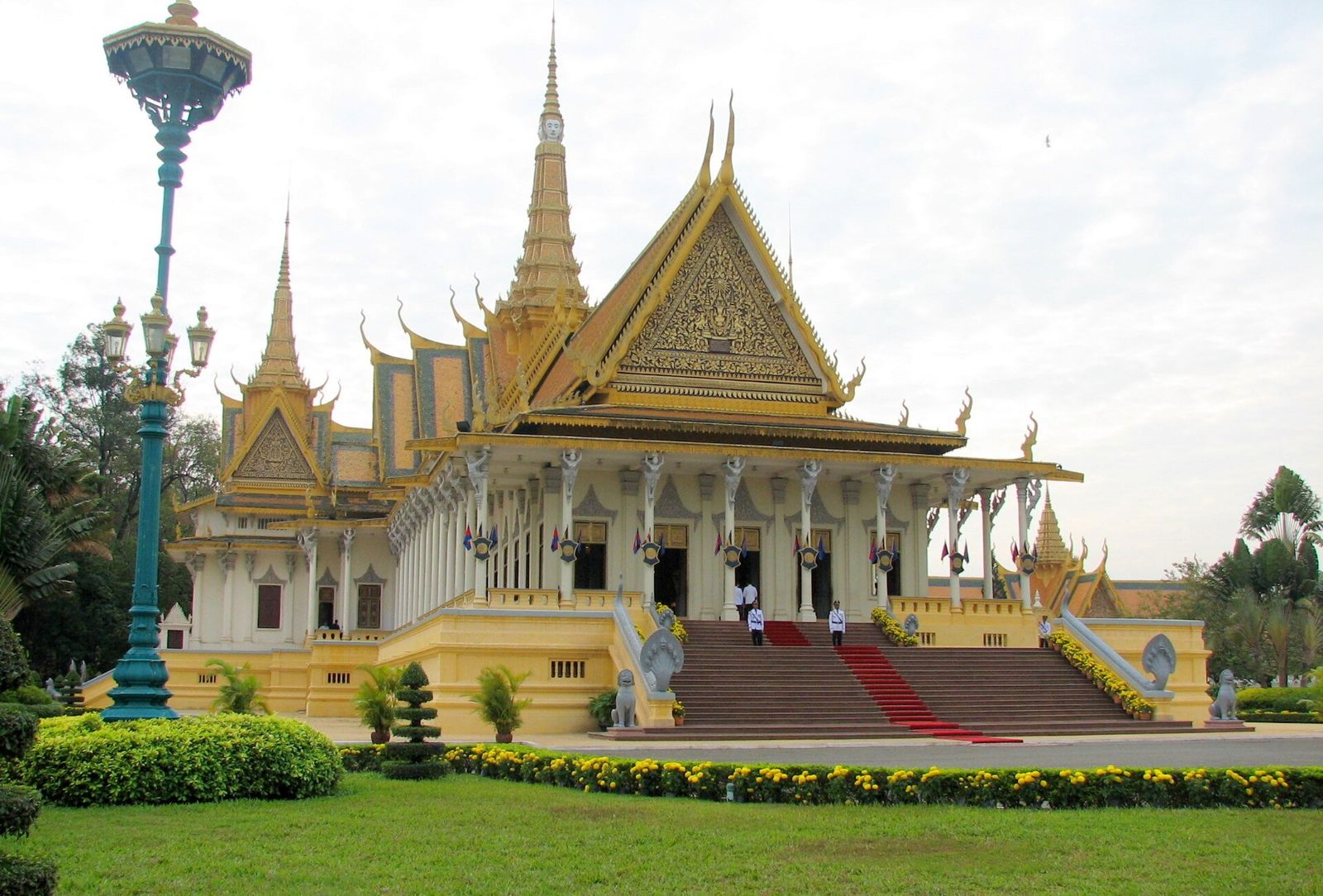
Photo: Royal Palace, Phnom Penh — Wikimedia Commons (CC BY-SA 3.0)