
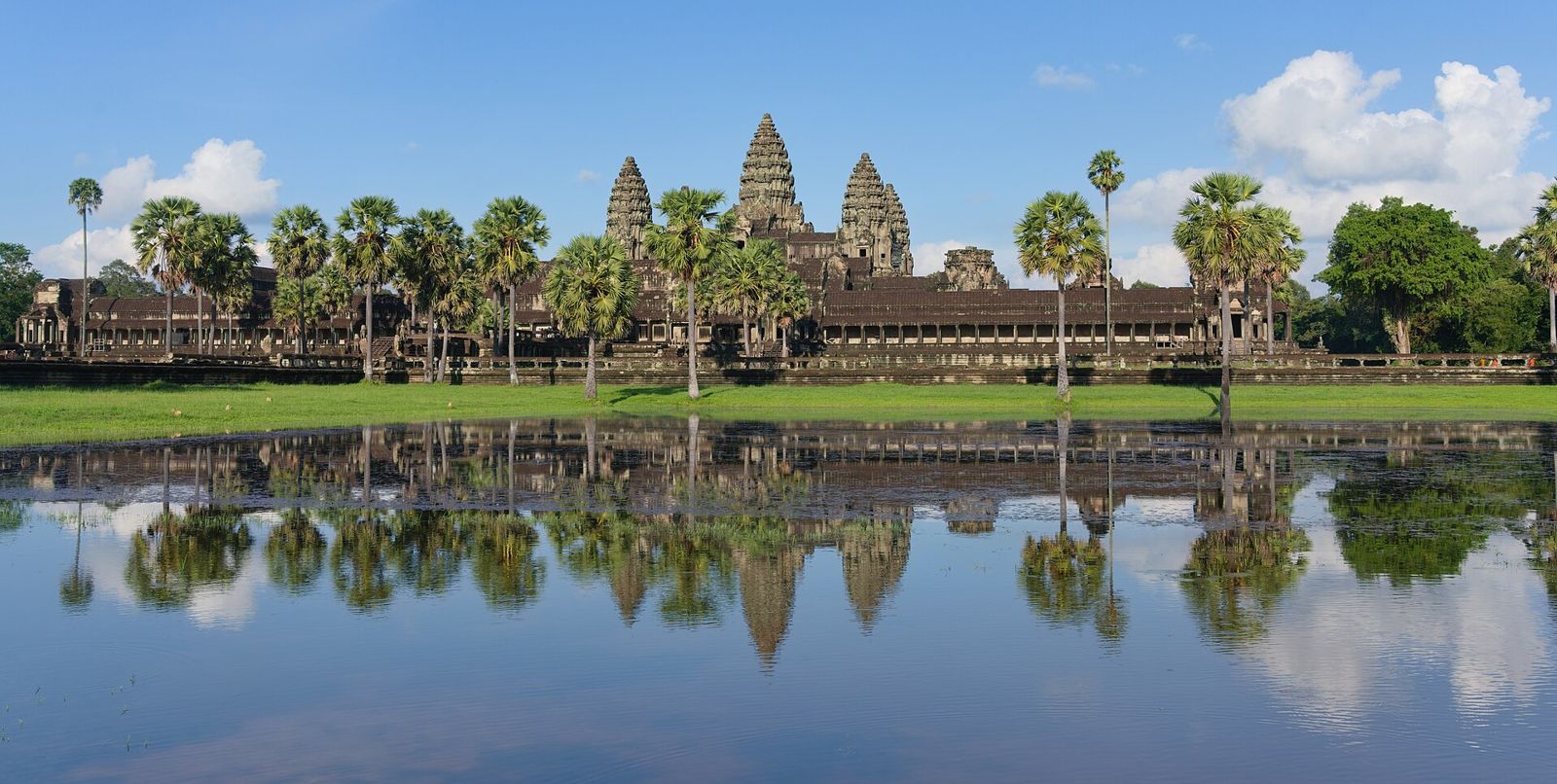
Siem Reap and Angkor
សៀមរាប និងអង្គរ
Siem Reap is the base for the Angkor Archaeological Park, a 400-square-kilometre spread of Khmer temple cities. This guide covers passes, realistic itineraries, getting around and the rules that catch visitors out.
Angkor pass
US$37 / 62 / 72
One, three and seven-day passes
Where to buy
Official ticket centre
Or online at the official portal
Time needed
2 – 3 days
One day covers only the highlights
Angkor passes: prices and rules
Passes are sold as one day at US$37, three days at US$62 and seven days at US$72. The three-day pass is valid for any three days within a ten-day window and the seven-day pass within a month, so you can alternate temple days with rest days. Children under twelve enter free with a passport as proof of age.
Buy at the official Angkor Enterprise ticket centre on Road 60, a few kilometres from town, or through the official online portal. Your photograph is taken and printed on the pass, which is checked at every temple entrance and at internal checkpoints — passes are non-transferable and losing one means buying again.
The ticket centre opens at 5am for sunrise visitors. Buying after 5pm gives you a pass dated for the following day while still allowing entry that same evening, which is a useful way to catch sunset on arrival day.
A few sites sit outside the standard pass: Beng Mealea, Koh Ker and Phnom Kulen charge separately. Confirm current prices before setting out, as they are adjusted periodically.
What to see in one, two or three days
With one day, do the small circuit: Angkor Wat at sunrise, then Angkor Thom with the Bayon's faces and the Terrace of Elephants, then Ta Prohm with its strangler figs. It is a full but manageable day if you finish by early afternoon.
A second day opens up the grand circuit — Preah Khan, Neak Pean, Ta Som and Pre Rup for sunset — plus Banteay Srei, a small pink-sandstone temple 35 kilometres out with the finest carving in the country, usually paired with the Landmine Museum or Kbal Spean's riverbed carvings.
A third day is best spent further out: Beng Mealea's collapsed and largely uncleared galleries, the Roluos group of ninth-century brick temples, or a boat trip to the floating villages of Kampong Phluk on the Tonle Sap. Two half-days beat one long day in the April heat.
Getting there and getting around
Siem Reap–Angkor International Airport opened in 2023 and sits about 50 kilometres east of town, a 45-60 minute transfer. Buses and minivans run frequently from Phnom Penh in five to seven hours, and there is a slower rail connection via Battambang.
Within the park, a tuk-tuk hired for the day is the standard choice — around US$20-25 for the small circuit and more for Banteay Srei or distant sites. Air-conditioned cars cost roughly double and make sense in the hot season. Bicycles work well for the small circuit if you start at dawn; e-bikes are widely rented.
Licensed English-speaking guides can be booked through hotels or the guide association. For a first visit, a half-day guide at Angkor Wat and the Bayon adds far more than an audio app.
Etiquette, timing and the town itself
Angkor is an active religious site. Shoulders and knees must be covered to climb the upper level of Angkor Wat, and visitors are turned away for vests or short shorts. Do not touch carvings, climb on rubble or use drones without a permit.
Sunrise at Angkor Wat is crowded; the reflecting pools fill from 5am. Quieter alternatives are sunrise at Srah Srang and sunset from Pre Rup or Phnom Bakheng, the latter with a visitor cap. Midday is the emptiest and hottest part of the day — carry more water than you expect to need.
In town, Pub Street and the night markets anchor the evening, while Kandal Village has the quieter cafés and boutiques. The Angkor National Museum, the Apsara dance shows and the Phare Cambodian Circus fill a rest day, and Old Market remains the best place for street food.
Frequently asked questions
- How much does an Angkor Wat ticket cost?
- A one-day Angkor pass is US$37, three days is US$62 and seven days is US$72. Children under twelve enter free with proof of age. Some outlying sites such as Beng Mealea, Koh Ker and Phnom Kulen charge separate fees.
- Where do I buy the Angkor pass?
- At the official Angkor Enterprise ticket centre on Road 60 outside Siem Reap, or through the official online portal. Your photo is printed on the pass and it is checked at every temple, so it cannot be shared or resold.
- How many days do I need at Angkor?
- One day covers Angkor Wat, Angkor Thom and Ta Prohm. Two to three days is the sweet spot, letting you add the grand circuit, Banteay Srei and a more distant site such as Beng Mealea without rushing in the heat.
- What should I wear to visit Angkor Wat?
- Shoulders and knees must be covered to enter the upper level of Angkor Wat, and modest dress is expected throughout the park. Light long trousers or a long skirt, a covered top, a hat and sturdy shoes are the practical combination.
- How do I get around the Angkor temples?
- A tuk-tuk hired for the day is the standard option, roughly US$20-25 for the small circuit and more for distant temples. Air-conditioned cars cost about double, and bicycles or e-bikes work well for the small circuit if you start early.
- Is Angkor Wat sunrise worth it?
- The light on the towers is exceptional, but the reflecting pools are crowded from 5am. If you prefer quiet, watch sunrise from Srah Srang instead and save Angkor Wat for mid-morning, when tour groups have moved on to the Bayon.
Keep reading
- Explore places to visit across Cambodia
- Buy or rent a house in Siem Reap
- Best time of year to visit Cambodia
- Money in Cambodia: riel, dollars and cards
- Public holidays and travel peaks
Photo: Angkor Wat — Wikimedia Commons (CC BY-SA 4.0)