
Cost of living in Cambodia
តម្លៃជីវភាពនៅកម្ពុជា
Cambodia remains one of the cheaper places in Southeast Asia to live, but the range is wide: a frugal single person and a family in an international-school bracket are living in two different economies. These are realistic monthly numbers, in US dollars, for Phnom Penh and the provinces.
Lean single
US$700 – 1,000
Local-style flat, street food, moto
Comfortable single
US$1,400 – 2,200
Serviced flat, gym, eating out
Family of four
US$4,000 +
Driven mainly by school fees
Rent: the number that decides your budget
In Phnom Penh, a simple one-bedroom flat in a Khmer-style building outside the centre runs US$200-350. A serviced one-bedroom apartment with a pool and gym in BKK1, Toul Kork or Chroy Changvar is typically US$450-800, and a three-bedroom family apartment or townhouse US$900-1,800. Serviced buildings usually include cleaning, water, rubbish and sometimes basic internet.
Siem Reap and Battambang run roughly 30-40% below Phnom Penh for the same standard; Kampot and Kep are cheaper still but with a thinner rental supply. Sihanoukville prices swing with construction cycles and are worth checking on the ground rather than online.
Leases are typically twelve months with one or two months' deposit. Rent is quoted and usually paid in US dollars. Negotiating 5-10% off an advertised price is normal, more if you pay several months up front.
Utilities, internet and phone
Electricity is the main variable cost because air conditioning dominates it. Expect US$30-60 a month for a modest flat with occasional AC and US$100-200 for a family home running AC most of the day. Tariffs are billed per kilowatt-hour and landlords sometimes add a markup — ask how the meter is read before signing.
Water is cheap, often US$5-15 a month, and frequently bundled into serviced rent. Bottled drinking water in 20-litre jugs costs US$1-2 delivered.
Fibre internet at 50-200 Mbps costs US$15-30 a month from providers such as Metfone, Cellcard and Smart. Mobile data is unusually cheap: a monthly package with tens of gigabytes runs US$5-12, and prepaid SIM cards are sold with passport registration for a couple of dollars.
Food, transport and everyday spending
A street or market meal costs US$1.50-3, a local restaurant dish US$3-6, and a Western restaurant main US$8-15. Cooking at home with market produce is very cheap; imported cheese, cereal and wine from supermarkets is not, and is where household grocery bills quietly inflate. Budget US$150-250 a month eating mostly local, US$400+ with regular Western meals and imports.
Transport is inexpensive. App-based tuk-tuks (PassApp, Grab) cost US$1-2.50 for short city trips. A second-hand 110cc motorbike costs US$400-900 to buy, or US$50-80 a month to rent, with petrol at roughly US$1 a litre. Long-distance buses between provinces are US$6-15.
Gym memberships run US$25-60, cinema tickets US$4-6, and a beer in a local spot US$0.75-1.50 against US$3-5 in a riverside bar. Domestic help — a part-time cleaner once or twice a week — is commonly US$60-120 a month.
Healthcare, schooling and the hidden costs
Basic consultations at international clinics in Phnom Penh cost US$30-60, and the better private hospitals handle most routine care. Serious or complex treatment is usually referred to Bangkok or Singapore, which is why residents carry insurance with regional evacuation cover — typically US$500-2,000 a year depending on age and cover level.
International school fees are the single largest expense for families: roughly US$3,000-8,000 a year at mid-tier schools and US$12,000-25,000 at the top international schools, per child. This is what pushes a family budget past US$4,000 a month.
Budget too for visa extensions (a twelve-month business extension plus agent fee), annual insurance renewals, and periodic flights home. Most costs in Cambodia are quoted in dollars, but small purchases come back in riel — see the money guide for how the dual-currency system works day to day.
Frequently asked questions
- How much money do you need to live in Cambodia per month?
- A frugal single person living locally manages on US$700-1,000. A comfortable expatriate lifestyle in Phnom Penh with a serviced apartment and regular restaurant meals runs US$1,400-2,200. Families with children in international school should budget US$4,000 or more.
- How much is rent in Phnom Penh?
- A basic one-bedroom flat outside the centre is US$200-350 a month. Serviced one-bedroom apartments with a pool and gym in BKK1 or Toul Kork are US$450-800, and three-bedroom family homes US$900-1,800.
- Is Cambodia cheaper than Thailand or Vietnam?
- Rent, alcohol and services are generally cheaper than in Bangkok and comparable to Vietnam's larger cities. Imported groceries and electricity are more expensive in Cambodia, and healthcare quality is lower, which offsets some of the saving.
- What is the average salary in Cambodia?
- The minimum wage in the garment sector is set annually and sits just over US$200 a month. Office salaries for Cambodian professionals commonly range from US$300 to US$800, while expatriate packages in NGOs, education and management are far higher.
- How much is electricity in Cambodia?
- Electricity is the main swing cost because of air conditioning. A modest apartment with occasional AC runs US$30-60 a month; a family house running AC most of the day can reach US$100-200. Check how your landlord meters and marks up power before signing.
- Can you live in Cambodia on US$1,000 a month?
- Yes, in most of the country, if you rent a local-style flat, eat mainly Khmer food, use tuk-tuks or a motorbike and keep imported groceries to a minimum. It leaves little room for international school fees, frequent flights or comprehensive insurance.
Keep reading
- Money in Cambodia: riel, dollars and gold
- Today's USD to KHR exchange rate
- Visas, extensions and long stays
- Rent or buy property in Phnom Penh
- Houses for sale and rent in Siem Reap
- Explore Phnom Penh on the map
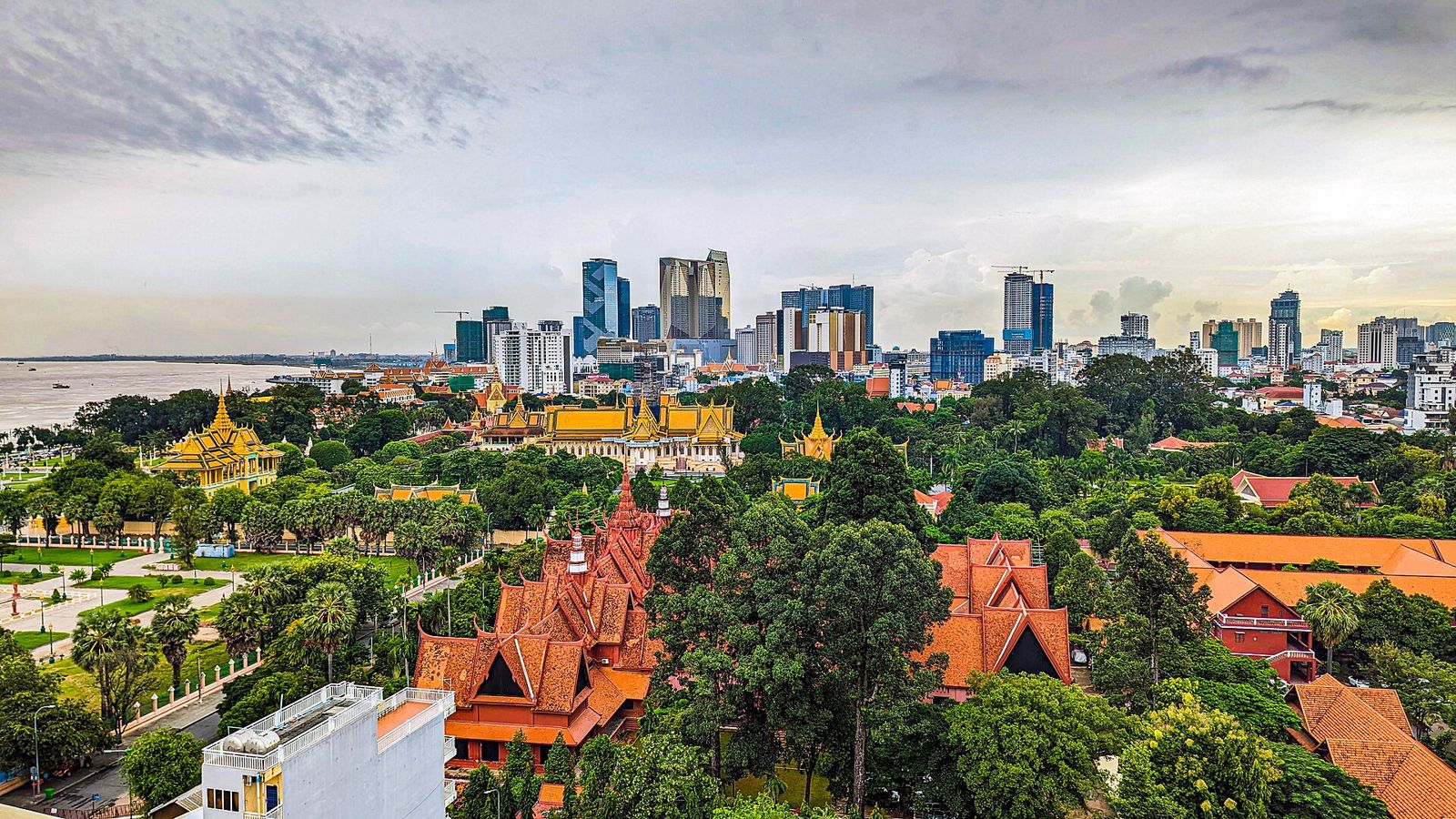
Photo: Phnom Penh skyline — Wikimedia Commons (CC BY-SA 4.0)