
Buying property in Cambodia
ការទិញអចលនទ្រព្យនៅកម្ពុជា
Foreigners can legally own property in Cambodia, but only in a specific form — and the title type matters more than the building. This guide explains what you can and cannot own, what buyers actually pay in Phnom Penh and Siem Reap, and how a purchase runs from offer to registration.
Foreign ownership
Above ground floor
Strata-titled units only, no land
Transfer tax
4%
Payable on hard-title transfers
Phnom Penh condo
US$1,300 – 2,800 / m²
Mid-range to prime districts
What foreigners can legally own
Cambodian law allows foreign nationals to own units in a co-owned building from the first floor upwards, through a strata title. Ground-floor units, basements and land itself cannot be foreign-owned, and no more than 70% of a building's private area may be held by foreigners. In practice this means condominiums and apartments in registered co-owned buildings are the straightforward route.
Houses, villas, shophouses and land can only be held by a Cambodian national or a company that is at least 51% Cambodian-owned. Buyers who want a landed home therefore either form a land-holding company, use a long-term lease of up to 50 years with a renewal option, or buy through a Cambodian spouse — each with different levels of legal protection.
Long leases registered at the cadastral office are the most common compromise for foreigners who want a house in Siem Reap or Kep. A registered lease is far stronger than an unregistered private agreement, so pay the registration cost rather than skipping it.
Title types: hard, soft and strata
Hard title is the strongest form of ownership, issued by the national cadastral administration and recorded in the central registry. It is slower to transfer and attracts the 4% transfer tax, but it is the title that survives a dispute.
Soft title is recorded only at commune or district level. Much of Cambodia's older residential stock still sits on soft title because it is cheaper and faster to transfer, but it carries real risk: overlapping claims are resolved less predictably and lenders are reluctant to accept it as collateral. Converting soft title to hard title before or during a purchase is common and worth budgeting for.
Strata title is the unit-level title issued inside a registered co-owned building, and it is the only category open to foreign buyers in their own name. Always confirm the building actually holds its co-ownership registration — some projects sell 'strata' units before the paperwork exists.
What property costs, city by city
In Phnom Penh, mid-range condominiums in areas such as Toul Kork, Chroy Changvar and Sen Sok trade around US$1,300-1,800 per square metre, while prime BKK1 and riverside stock reaches US$2,200-2,800. A one-bedroom unit of 45-60 m² therefore commonly lands between US$70,000 and US$150,000.
Siem Reap is materially cheaper: two- and three-bedroom houses on the outskirts start from roughly US$60,000, town-centre villas run US$120,000-300,000, and land near the airport road is priced per square metre with wide variation. Sihanoukville is the most volatile market in the country and should be inspected in person.
Rental yields on well-located Phnom Penh condominiums typically sit between 4% and 6% gross before management fees, service charges and vacancy. Service charges of US$0.80-1.50 per square metre per month are normal in serviced buildings and are often forgotten in yield calculations.
The purchase process step by step
First, verify the title at the cadastral office and confirm the seller's identity matches it. A lawyer or licensed agent runs this check, and it is the single most valuable US$500-1,500 you will spend. Check for existing mortgages, caveats, unpaid property tax and, for houses, whether the boundaries on the ground match the plan.
Second, sign a deposit or reservation agreement — usually 5-10% — with clear conditions allowing the deposit to be refunded if title checks fail. Third, sign the sale and purchase agreement before a notary, pay the balance, and lodge the transfer with the cadastral administration. Registration of a hard-title transfer typically takes several weeks to a few months.
Budget beyond the price: 4% transfer tax on hard title, roughly 1-3% in legal and agency costs, and annual property tax of 0.1% on the value above KHR 100 million. Off-plan buyers should also confirm the developer's construction permit and payment-schedule protections before committing.
Frequently asked questions
- Can a foreigner buy property in Cambodia?
- Yes. Foreigners can own strata-titled units from the first floor upwards in registered co-owned buildings, up to 70% of a building's private area. Foreigners cannot own land or ground-floor units in their own name.
- Can a foreigner buy a house in Cambodia?
- Not directly in their own name, because a house includes land. The usual routes are a registered long-term lease of up to 50 years, a Cambodian-majority land-holding company, or purchase through a Cambodian spouse or nominee — each with different legal protection.
- What is the difference between hard title and soft title?
- Hard title is registered nationally at the cadastral administration and is the strongest proof of ownership. Soft title is recorded only at commune or district level, is cheaper and faster to transfer, but carries greater dispute risk and is harder to mortgage.
- How much does a condo cost in Phnom Penh?
- Mid-range districts run about US$1,300-1,800 per square metre and prime BKK1 or riverside stock US$2,200-2,800. A typical one-bedroom unit costs between US$70,000 and US$150,000.
- What taxes do you pay when buying property in Cambodia?
- A 4% transfer tax applies to hard-title transfers, plus legal and agency costs of roughly 1-3%. Owners then pay annual property tax of 0.1% on the portion of value above KHR 100 million, and rental income is taxed separately.
- Is buying property in Cambodia a good investment?
- Gross rental yields on well-located Phnom Penh condominiums are typically 4-6%, higher than many regional capitals, but liquidity is thin and resale can be slow. Title verification and building quality matter far more to outcomes than headline yield.
Keep reading
- Browse property for sale and rent in Cambodia
- Houses for sale and rent in Siem Reap
- Property in Phnom Penh
- Renting an apartment in Cambodia
- Cost of living in Cambodia
- Visas, extensions and long stays
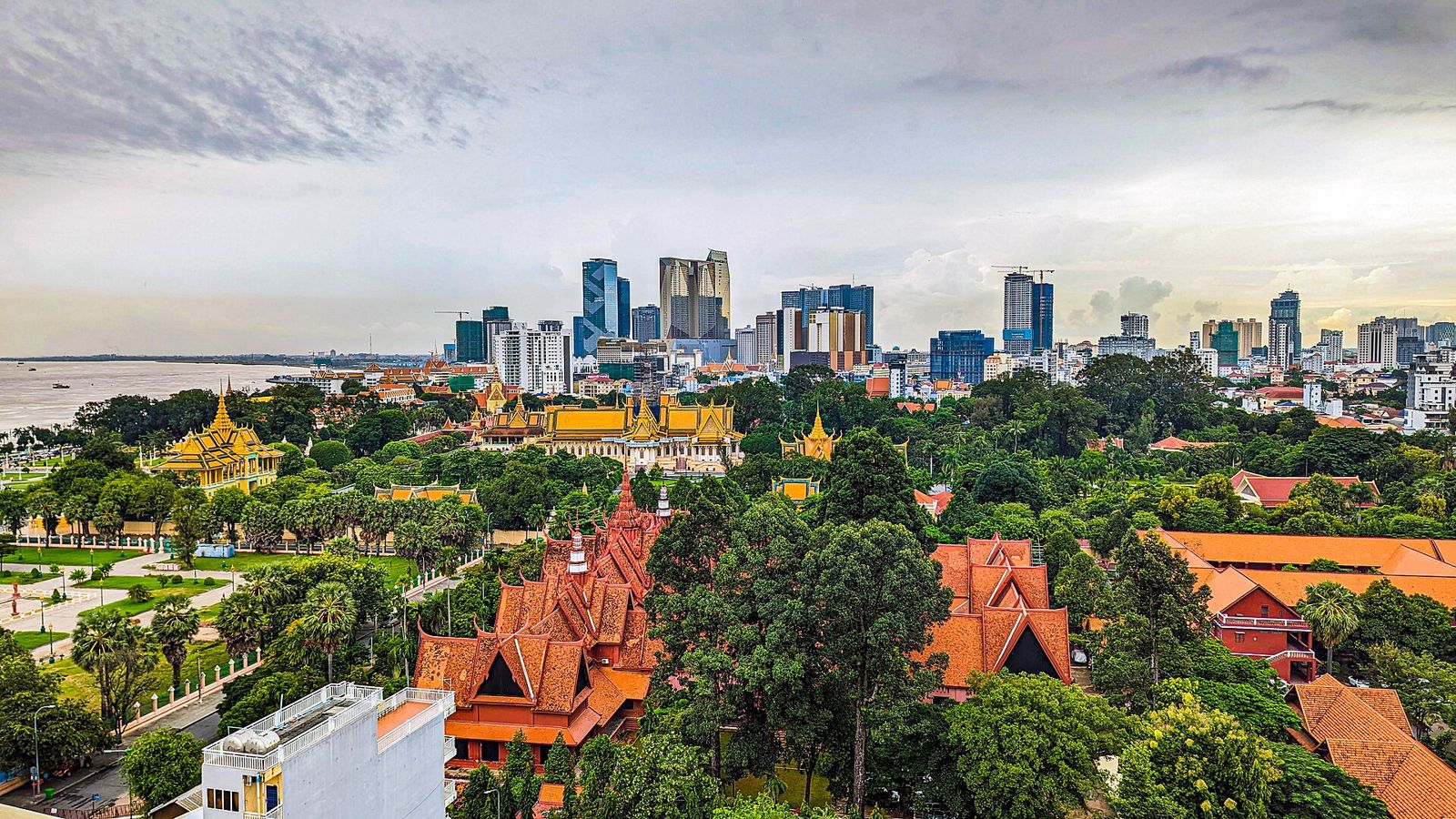
Photo: Phnom Penh skyline — Wikimedia Commons (CC BY-SA 4.0)