
Working in Cambodia
ការងារនៅកម្ពុជា
Cambodia is one of the easier countries in the region for a foreigner to work in legally: the visa is renewable indefinitely and the paperwork is manageable. What is harder is finding a role that pays well, because local salary levels anchor most of the market.
Visa type
E-class (business)
Extendable 1, 3, 6 or 12 months
Work permit
Annual
Renewed each calendar year
Teaching salary
US$1,000 – 2,000
Full-time, Phnom Penh
The visa and work permit route
Arrive on an E-class visa (often called the business or ordinary visa) rather than a tourist visa — it costs a few dollars more and is the only one that can be extended long term. Once inside the country, an agent or your employer converts it into a six- or twelve-month extension, which is the practical basis for living and working here.
Separately, every foreign employee needs a work permit and employment card issued by the Ministry of Labour, renewed each calendar year. Employers are legally responsible for obtaining it, and compliant companies handle the filing; smaller employers sometimes leave it to the employee, in which case an agent will process it for a modest fee.
Applications for the following year typically open early in the year, and late filings attract penalties. Keep copies of your passport, visa extension, employment contract, medical certificate and photographs — the same documents are requested every renewal.
Which sectors actually hire foreigners
Teaching English remains the largest single entry point. International schools pay best and expect a degree plus a recognised teaching qualification; language centres hire more freely, often on hourly rates. Full-time teaching in Phnom Penh commonly pays US$1,000-2,000 a month, with the top international schools well above that plus housing.
Development and NGO work is the second major sector, concentrated in Phnom Penh, with pay ranging from local-scale stipends to internationally benchmarked contracts. Hospitality and tourism hire in Siem Reap and along the coast, usually at management level for foreigners.
Beyond that, the growth areas are finance, real estate, logistics, digital marketing and software. Remote workers employed abroad make up a large and quiet part of the foreign community, particularly in Phnom Penh, Siem Reap and Kampot, where fast fibre and cheap rent make the maths work.
Salaries, contracts and labour rules
The national minimum wage is set annually for the garment and footwear sector and sits just over US$200 a month; other sectors follow it loosely. Cambodian professional salaries commonly run US$300-800, while foreign hires in management, education and development earn multiples of that. Salaries are usually quoted in US dollars.
The labour law provides for a maximum 48-hour week, overtime premiums, 18 days of annual leave plus public holidays, maternity leave and seniority payments. Fixed-duration contracts cannot exceed two years in total before converting to an undetermined-duration contract, which carries stronger termination protection.
Salary tax is withheld by the employer on a progressive scale, and residents are taxed on worldwide employment income once they spend more than 182 days in the country. Confirm whether an offer is quoted gross or net — the difference is significant and often left vague.
Finding a job and settling in
Most hiring happens through local job boards, LinkedIn, sector-specific Facebook groups and direct approaches. Being physically in the country improves your odds substantially: many employers interview only candidates who can start within weeks, and few will sponsor a relocation for a first role.
Bring original degree certificates and, where relevant, get them certified before you arrive — international schools and some employers ask for them, and arranging authentication remotely is slow. A police clearance from your home country is increasingly requested for education roles.
Open a local bank account once you have an employment contract and a valid extension. Salaries are often paid into a local account, and having one makes rent, utilities and visa renewals considerably easier to manage.
Frequently asked questions
- Do foreigners need a work permit in Cambodia?
- Yes. Every foreign employee needs a work permit and employment card from the Ministry of Labour, renewed each calendar year, on top of an extended E-class business visa. The employer is legally responsible for obtaining it.
- How much does a work permit cost in Cambodia?
- The official government fee is modest — around US$100 or less per year — but most people pay an agent or employer service fee on top, bringing the practical total to roughly US$150-250 including the medical certificate.
- What jobs can foreigners get in Cambodia?
- Teaching English, international-school teaching, NGO and development work, hospitality and tourism management, finance, real estate, marketing and software are the main sectors. Remote work for a foreign employer is also very common.
- How much do English teachers earn in Cambodia?
- Full-time language-centre and school teaching in Phnom Penh typically pays US$1,000-2,000 a month. Top international schools pay considerably more, often with housing and flights, but require a degree plus a recognised teaching qualification.
- Can I work in Cambodia on a tourist visa?
- No. A tourist visa cannot be extended long term and does not support a work permit. Enter on an E-class business visa instead, which can be extended for six or twelve months and renewed indefinitely.
- How much income tax do you pay in Cambodia?
- Salary tax is withheld by the employer on a progressive scale rising to 20% on higher monthly income. Anyone spending more than 182 days in Cambodia in a year is treated as a tax resident on worldwide employment income.
Keep reading
- Cambodia visas, extensions and overstays
- Cost of living in Cambodia
- Renting an apartment in Cambodia
- Money in Cambodia: riel and dollars
- Property in Phnom Penh
- Phnom Penh city guide
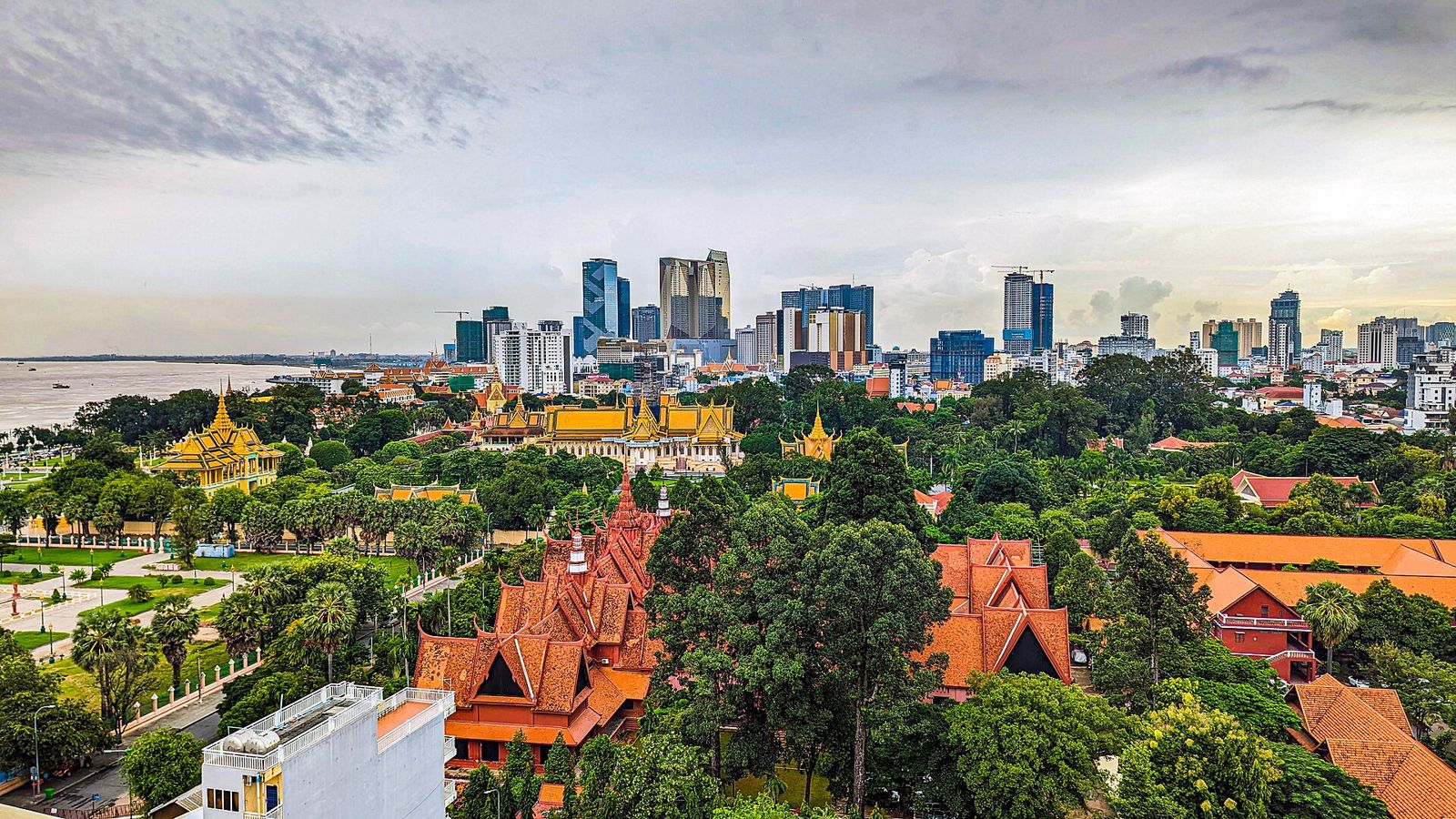
Photo: Phnom Penh skyline — Wikimedia Commons (CC BY-SA 4.0)